Thursday, 22 July 2010

Imagine Cup. Change the world


So its been a week or so since I've come back from the 2010 Imagine Cup and I have a bit more time to talk about it.

Hopefully if you were following the Imagine Cup on twitter (using the ImagineCup tag) you may have heard about the UK's one man army ...which was me!
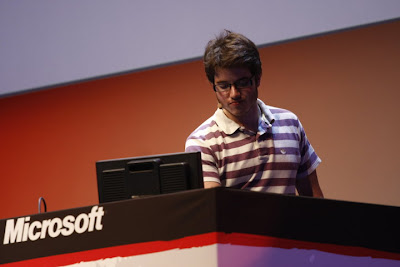
I was a rather strange entry to say the least for the embedded competition. Firstly in a category designed for teams of 3 or 4, I was on my own, making things interesting when I had to design, build, test and present the entry all by my self. A tall challenge but I pulled it off.

So my entry; as you can see above is an augmented reality system for blind and partially sighted individuals to help them with everyday tasks to give them back their independence. For more info on how it was built have a look at my other blog entries about it.

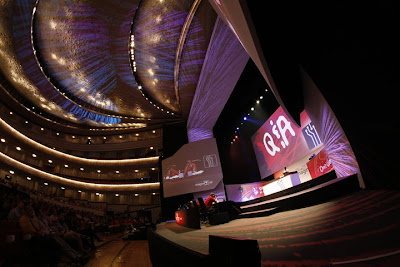
Well did it make me famous? Well I got to present on one of Europe's largest stages to around 1,000 people and you might find me on quite a few blogs about the competition.
So what am I up to now? Well I have a job, writing code for various embedded platforms but I hope to continue giving advice and mentoring with the Imagine Cup and I have quite a few ideas for new projects to take up my spare time.

If you want to find out more, here are some other peoples blog posts:

Imagine Cup Blog: Team EyeSight

Adam Daniels: Alls fair in tech and war

Flickr: EyeSight Presentation

Microsoft PressPass

The Open Bracket: Think Big, Act Big

Scientific American: Compassionate Coding


Monday, 12 July 2010

The end of the Imagine Cup, The start of a new job

Well its been a busy week or so. Finishing my degree, going to the Imagine Cup finals in Poland and then going out in the real world to get a job.

Well the Imagine Cup was great fun, got in the final six of the embedded category and much to the surprise of most (including myself) I didn't quite manage to get a placing. Well done everyone.

Since I've got back I went out and got a job ...in embedded computing and tomorrow I am off to my graduation.

Will write more alas I'm stuck on rather flakey mobile broadband

Sunday, 6 June 2010

Senses - How its been coded...

So there are lots of things that go into my Senses Project so here's how I have done some of them.

The Server:
This runs most of the processing algorithms, including facial detection/recognition, speech recognition and Optical Character Recognition(OCR). So lets Break them down:

Speech Recognition - Uses Windows built in Speech API (SAPI) for Speech Recognition and Text to speech

Optical Character Recognition - Uses the OCR engine built into Office 2007 Imaging

Facial Recognition - This was a tricky one to find, but in the end I am using a trial version of the .Net facial recognition framework created by Luxand. The images that get processed are extracted from the users computer and the users friends off of Facebook using the Facebook .Net API found on Codeplex

The Windows Mobile Device
This is just your run of the mill Windows Mobile .Net Compact framework app, it communicates with the Server and transmits data such as audio and images. The interface is the interesting part though, how do you design a UI for a blind person?
The UI - As the user can not see the items on the screen, whenever they move their finger over them. Text to Speech kicks in and tells them the option, when they find the one they want they just have to double tap ...simple!
Windows Embedded & .Net Micro 'thingy'
The heart of the solution is a Windows Embedded device, an eBox 3300. This runs some of the image processing shizzle and performs the solutions audio functionality. It is connected to another device running the .Net Micro Framework and has a screen which provides information as the eBox itself won't be connected to a PC.

Friday, 4 June 2010

Imagine Cup 2010 - I'm through to the finals!

Well its been a busy couple of weeks but yet another piece of amazing news has happened to me. My embedded entry for this years Imagine Cup has been selected and I am off to Warsaw at the start of July to represent the UK.

So what's my big Idea?

Well after seeing a visually impaired person struggling in a supermarket I thought that technology could help, therefore I designed Senses.

It is an augmented reality system for blind and partially sighted people, incorporating visual, tactile and audio interfaces. Utilising the latest Windows Embedded, mobile and cloud technologies this project aims to improve overall quality of life, this is achieved by providing a means to better perform day to day tasks, such as reading text, identifying objects and people, and avoiding obstacles when walking.

This would be achieved by affectively adding a second set of eyes via the use of an external wide focus web camera attached to the user, and a more precise camera within a pre-existing Windows mobile device. These cameras would provide such tasks as Object Recognition, Facial Recognition and Optical Character Recognition (OCR). The augmented reality interaction between the user and the device would come via speech recognition via a wearable microphone, and response would come from text to speech functionally in a set of headphones.

If you are interested, check out my promotional video on youtube.

Friday, 28 May 2010

My Final Year Project

Well I guess a few of you noticed that I haven't updated my blog recently, this was mainly due to me finishing my Final Year Project at Uni. So I thought I would explain what it was about.

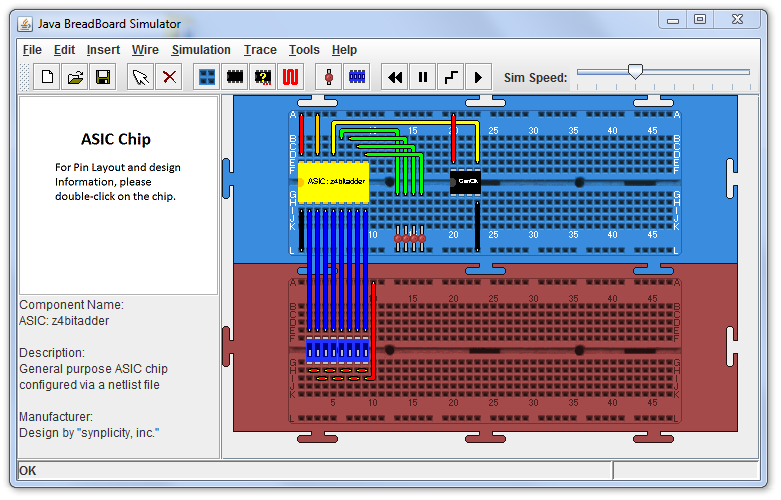
Our department created through several student projects a digital circuit simulator in Java.


It allows users to add a variety of different components, wire them up and then simulate them. Great for electronics hobbyists or students.

What I did was extend this so Field Programmable Gate Arrays (FPGA's) could be simulated using the tool.

An FPGA is made up of a combination of Logic Blocks, IO Blocks and interconnections wiring everything up.

Each logic block is made up of a variety of different primitive components interconnected, usually this consists of a Look Up Table, Multiplexer and some combinational logic. Below is a very simple CLB from an early Xilinx FPGA.


Now the important thing for me are the primitive components, which I have to model individually. Which in the case of the Xilinx XC2000, a very early FPGA is over 400 different components! Below is the same CLB but with the primitives highlighted.

Using an Event-Driven Discrete Modelling Simulation, these primitives were modelled and their interconnections simulated. Thus creating a working model.
And whats more, it only took around 35,000 lines of code!

Wednesday, 18 November 2009

Imagine Cup 2010

So its that time of year again where things start to ramp up for the Imagine Cup, which this year is being held in Poland.

For those of you that don't know what the Imagine Cup is, it is the worlds largest student technology competition that brings out the smartest students to help solve some of the worlds largest problems. Like last year it will be themed around the 8 Millennium goals set out by the UN, however to help you along the way, the UK team have contacted various charities to give possible ideas on projects that you can implement. To have a look at these and to find out more, visit the UK imagine cup website:


I'm still alive

Well its been a hectic few weeks, but yes I am still alive and I have a lot of content to post to my blog, some of which:

My uni project using MS technologies
Visual Studio 2010
Review of my Wireless Mobile Mouse 6000
What virtualisation tool is best to run Windows on Mac

Along with this I will have the usual talks about various projects I've been working on and my entry into the imagine cup.